What’s to come
After taking a brake from this project I think it’s about time to start working on the next stage, that being updates to all previously completed models…
Now I know you may be thinking that I’ve gone mad because they do look good, however, particularly where the 6 wheel coaches are concerned, I’ve found myself getting increasingly dissatisfied with the final result. As for the reason, well when I started this project I had next to no experience 3D modeling, designing models and didn’t even have any proper drawings as a result a lot of the key elements of the 6 wheel chassis and bodies are, despite numerous updates over the years, more or less, depending on example, flawed in numerous major ways. I also feel there are ways for me to make these more detailed and realistic and so that’s one of the key things I’m addressing: The main way I’m going about this is through updating the chassis detail, which was definitely better on the 8 wheel stock, however even those pale in comparison to the test I did on the chassis of the Dia. 281 3rd brake:
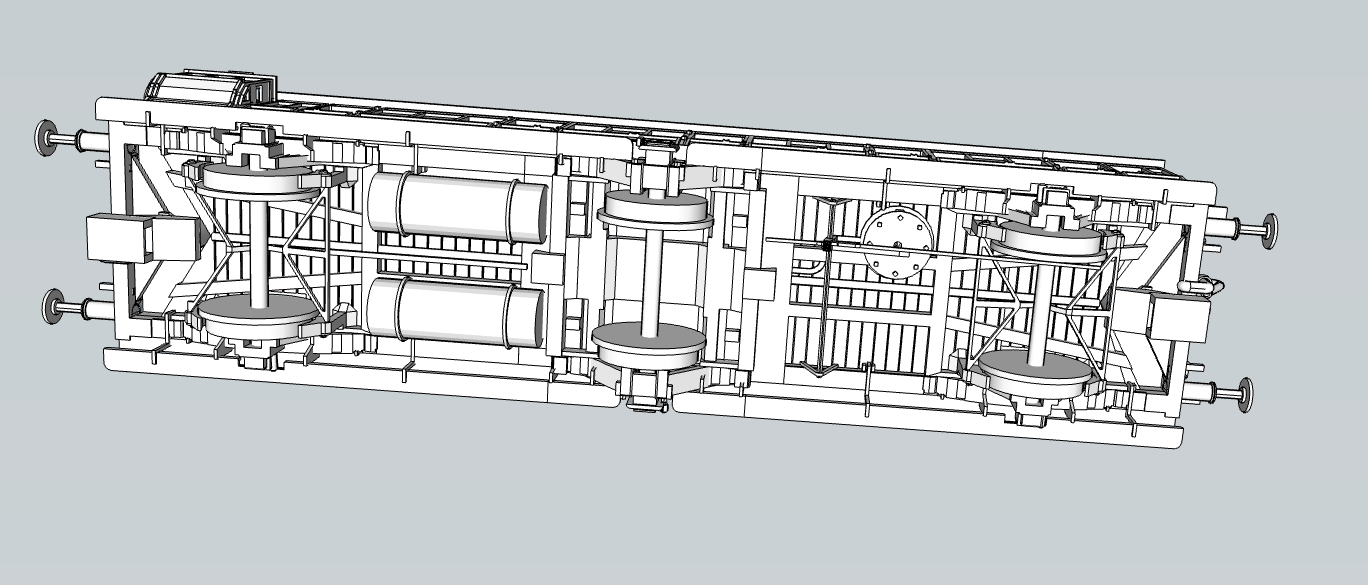
I hope you’ll agree that this looks way more refined and despite the fact that there are still a couple of things to rectify, I’m really pleased with the final result, even if compromises have had to be made to account for the center axel compensation & kinematic coupling mechanism.
Another thing I’m doing is expanding the diagrams covered. I have long been unhappy with the variety of the 6 wheel coaches and now I’m taking the first steps in rectifying. Before getting into the specifics I think it would be important to define what a diagram number actually means in this context. The first thing we need to get out of the way is that vehicles are not built o diagram numbers, but rather to drawing numbers, so now you may be wondering what on earth could be the purpose of a diagram number.
Diagram numbers are what appear in a railway’s diagram book which is used to catalog all of a railways vehicles with some basic information about them and some kind of drawing that either illustrates the interior or also the exterior of a vehicle. Now what makes this more complex is that a number entry may contain more than one kind of vehicles (drawing), however only the most numerous will be illustrated. The GNR devised a set of rules for attributing diagram numbers to it’s coach fleet:
A diagram contains vehicles that share:
- Number of wheels and chassis type (rigid & bogie 8 wheel coaches are categorized separately)
- width
- order & type of compartments
Now this seams simple enough and it probably suits the vast majority of people’s needs, but as someone that wants to represent GNR stock from as early as possible we run into a bit of an issue, as the first edition of the GNR’s carriage diagram book was only published in 1906 and the GNR was established in 1846. 60 years earlier.
Not only is this a problem because all stock that hadn’t lasted until 1906 is practically undocumented (with the exception of number, type & if you’re lucky compartment arrangement), the original compartment type before declassification was
ignored meaning that many early vehicles and especially the ones with 2nd class are very hard, if not impossible to model.
As to try to preserve these lesser-known vehicles I’m planning on splitting up posts about diagrams by drawing instead and changing the attribute ‘Diagram’ to either ‘Built as per diagram’, ‘Attributed to diagram (after reclassification)’ or ‘Converted to diagram’
Finally I’m also planning on adding more information on the post about each diagram drawing. And also here is the current plan
Chassis:
- 32’1 ½” (31’ 11 ⅝”) –Dia 243 (wheelbase 1)
-Dia 245 (wheelbase 2, alternate seats for 2nd class examples)
- 32’ 9” –Dia 156 (alter wheelbase, include alt examples for dias. 245 & 155)
- 33’ 6 ⅞” –Dia 84 (start from scratch)
- 33’ 10 ½” –Dia 164L (start from scratch)
-Dia 213 (alternate length, start from scratch, include 3rd class declassifications for dia 281)
-Dia 214 (start from scratch)
-Dia 281 (alternate length, start from scratch, include full 3rd, composite 3rd & 2nd , composite 3rd & 1st )
- 34’ 10 ½” –Dia 155 (good to go)
-Dia 242 (start from scratch, create alternate wheelbase)
- 35’ 0” –Dia 153 (start from scratch(altered dia. 154))
-Dia 154 (start from scratch)
- 35’ 10 ½” –Dia 213 (start from scratch)
- 37’ 0 ½” –Dia 239 (widen body!, redo corridor connectors & vestibules)
-Dia 240 (widen body!, redo corridor connectors & vestibules)
- 37’ 4 ½” –Dia 149 (shorten from original)
-Dia 164C (shorten from original, widen body!)
If you have any questions, don’t hesitate to ask them!